
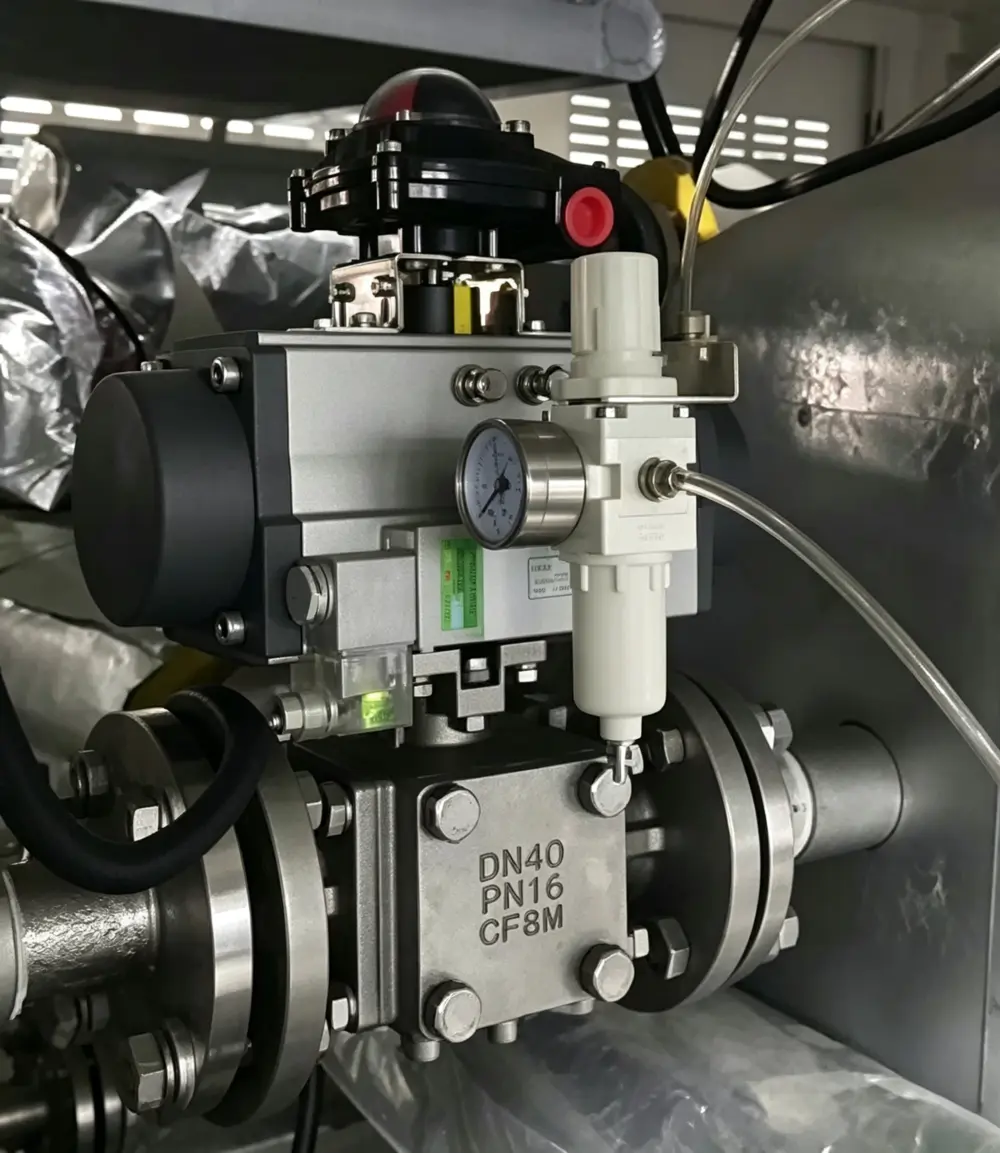
For ball valves on high‑low‑temperature alternating test benches, sticking during opening‑closing operations is mostly caused by dimensional deformation of valve seats resulting from thermal expansion and contraction. For working conditions with a wide temperature range of ‑40 °C to 135 °C, sticking faults induced by seat deformation can be resolved by prioritizing valve seat materials with excellent thermal stability combined with structural optimizations.
1. Project Background
Operating Conditions: Frequent thermal cycling with process temperatures ranging from ‑40 °C to 135 °C.
Fault Symptoms: After switching media from the ‑20 °C Line B to the 90 °C Line A, the valve exhibited sticking and jerky actuation. Poor valve operation reduced test‑bench throughput and created potential equipment‑safety hazards.
2. Root-Cause Analysis
Preliminary checks ruled out issues with the air supply and pneumatic actuator. The fault originated within the valve‑seat sealing assembly, and the detailed causes are analyzed as follows:
Note: Standard room‑temperature seat materials are not suitable for large‑delta‑T thermal‑cycle applications. Conventional sealing materials are prone to deformation and galling under alternating hot‑cold conditions.
3. Solutions for Seat-Deformation-Induced Sticking
A multi‑faceted remediation strategy covering material replacement, structural upgrades and on‑site maintenance was implemented to solve the valve sticking problem fundamentally:
- Install high‑thermal‑stability valve seats: Deploy application‑specific seat materials with minimal dimensional variation across temperature cycles. These materials maintain proper ball‑to‑seat clearance over the full ‑40 °C to 135 °C operating window and enable smooth valve actuation.
- Reinforce valve‑seat geometry: Improve seat rigidity through design adjustments including increased wall thickness and reinforcing features. Enhanced structural stiffness mitigates dimensional distortion caused by temperature fluctuations.
- Revise the complete sealing assembly: Upgrade the sealing system to deliver reliable sealing performance across wide temperature ranges. The revised design prevents over‑tight sealing contact at extreme temperatures while preserving sealing integrity and operational smoothness.
- Implement enhanced on‑site maintenance practices: Schedule periodic inspections to assess seat wear and deformation. Optimize process‑control logic to limit abrupt thermal shocks and reduce cyclic thermal stress on sealing components.
4. Application-Selection Reference Table
| Item | Original Configuration Issues | Revised Requirements | Typical Applications |
| Operating Temperature | Unable to withstand cyclic temperature swings from ‑40 °C to 135 °C | Application‑specific wide‑temperature‑range seats with low thermal‑expansion coefficients | Thermal cycle test benches, alternating‑temperature process piping |
| Failure Mode | Thermal expansion / contraction leading to valve sticking | Controlled deformation and stable actuation torque | Industrial test equipment, test‑loop piping |
| Structural Features | Standard off‑the‑rack seats without anti‑deformation provisions | Mechanically reinforced seats engineered for large‑temperature‑difference service | 3‑way and multi‑port switching ball valves |
5. Key Takeaways
Severe temperature fluctuations from thermal cycling represent a major root cause of ball‑valve seat failure. Many projects focus solely on pressure and process media while overlooking sealing‑component deformation driven by alternating temperatures, resulting in in‑service sticking problems. Temperature‑cycle amplitude must be fully evaluated during valve selection. Matching seat materials and mechanical designs to actual thermal conditions prevents faults at the source and improves long‑term system reliability.
6. Frequently Asked Questions
Q1: Why does my ball valve stick under large‑delta‑T thermal‑cycle service? A1: Sticking is most often caused by dimensional deformation of the valve seat due to thermal expansion and contraction. Seat distortion reduces ball‑seat clearance and raises actuation torque. Standard room‑temperature sealing materials are not fit‑for‑purpose; select sealing grades with superior thermal stability.
Q2: How should I specify valve seats for a 3‑way ball valve operating at ‑40 °C to 135 °C on a test bench? A2: Prioritize dedicated seat materials featuring low thermal‑expansion rates and stable performance over wide temperature ranges. In addition, specify mechanically robust seat construction to minimize thermally induced deformation and actuation sticking.
Q3: Can I fix seat‑deformation‑caused sticking simply by installing a higher‑torque actuator? A3: This approach is not recommended. Larger actuators may temporarily overcome mechanical galling, yet persistent compressive loading accelerates seat wear. Leakage will develop quickly as sealing surfaces degrade. The preferred remedy is to fit thermally compatible seats and implement structural improvements.
Q4: Can ball valves rated for ambient‑temperature service be reused directly on thermal‑cycle test benches? A4: Direct reuse is discouraged. Seals sized for room‑temperature operation are not engineered for repeated hot‑cold cycling and will deform and seize. Valves must be re‑specified for the full actual temperature envelope.
7. Application-Specific Recommendations
If you need assistance with valve selection for high‑low‑temperature cyclic conditions, share your operating temperature range, process media and valve nominal size to receive customized recommendations for seat materials and mechanical configuration.